The Growing Demand Behind Artificial Intelligence
From healthcare and finance to manufacturing, logistics, research, and customer service, artificial intelligence is driving an unprecedented demand for computing power.
Behind every chatbot, image generator, recommendation engine, and large language model are data centers filled with equipment operating continuously.
Most public conversations focus on a single question:
How do we generate enough electricity to power AI?
That is an important question. But it may not be the first one we should ask.
A better question might be:
How much energy and water are being wasted before we generate a single additional kilowatt?
The Cost of Operating at Scale
Modern AI data centers require much more than servers. Their supporting infrastructure may include:
- Transformers and electrical distribution equipment
- Chillers, cooling towers, pumps, and fans
- Computer-room air-conditioning and air-handling systems
- Backup power and resilience infrastructure
- Networking, monitoring, and security systems
- Water treatment and wastewater systems
Each system has an operating cost. When a facility runs 24 hours a day, small losses repeated every second can accumulate into substantial annual expenses.
Some Inefficiencies Hide in Plain Sight
Electrical systems do not always operate under perfect conditions. Distribution losses, harmonic distortion, voltage conditions, equipment stress, and inefficient operation can create unnecessary consumption and additional heat.
Cooling systems can also consume more electricity or water than necessary, depending on equipment design, system controls, flow conditions, maintenance, environmental conditions, and operational practices.
These costs are often accepted as unavoidable. In some facilities, they may represent opportunities for improvement.
Electrical Opportunity
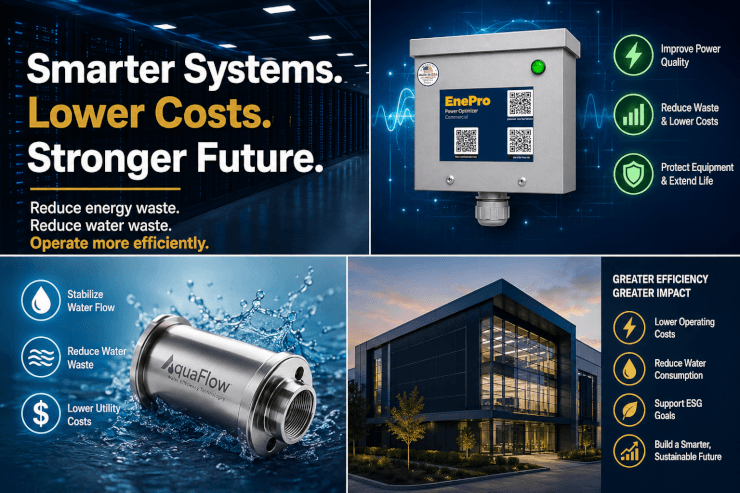
Improving power quality and reducing avoidable electrical losses may help lower operating expenses, reduce stress on connected equipment, and support more efficient facility performance.
Water Opportunity
Improving water-flow conditions and reducing unnecessary measured usage may help lower water and sewer expenses in facilities where water plays a major role in cooling and operations.
Looking Beyond More Power
Innovation is not always about producing more energy.
Sometimes the opportunity is using existing energy more intelligently.
Emerging technologies are giving facility operators new ways to evaluate electrical performance, improve power quality, manage flow conditions, reduce avoidable consumption, and support infrastructure efficiency without changing the mission of the data center itself.
Every facility is different, and no technology should be recommended without proper technical review. However, efficiency improvements may influence several important areas:
- Operating expenses
- Electrical waste
- Water and sewer costs
- Equipment stress
- Cooling-system performance
- Sustainability reporting
- Capacity planning
- Infrastructure resilience
Water Is Part of the AI Conversation
Electricity is not the only resource under pressure.
Many data centers depend on water-intensive cooling systems to manage the heat produced by servers and supporting equipment. Water may be used in cooling towers, condenser loops, evaporative cooling systems, heat exchangers, and other facility processes.
As communities face concerns about water availability and utility costs continue to rise, water efficiency is becoming increasingly important.
Reducing unnecessary water use may create more than one benefit. A facility may reduce water purchases, sewer charges, treatment requirements, pumping demand, and wastewater volume, depending on how the property is billed and operated.
Reduce Before You Produce
For years, the energy conversation has centered on producing more.
Production matters, and renewable energy, storage, microgrids, and resilient power systems will continue to play an important role in data-center development.
But production should not automatically be the first step.
Every kilowatt that is not wasted does not need to be generated.
Every gallon of water that is not unnecessarily consumed does not need to be pumped, treated, purchased, or discharged.
Efficiency and generation are not competing ideas. They work better together.
The Financial Impact Can Be Larger Than It Looks
In a small building, an efficiency improvement may create a modest result.
Inside a large facility operating continuously, the same percentage improvement can have a much greater financial impact because the underlying consumption is so large.
This does not mean every facility will achieve the same outcome. Savings depend on the infrastructure, utility rates, operating profile, billing structure, existing equipment, installation conditions, and measured performance.
It does mean that data-center operators should be willing to examine areas that are often overlooked.
The Future Will Belong to Smarter Infrastructure
The next generation of AI infrastructure will not be defined only by faster processors, larger campuses, or greater computing density.
It will also be measured by how intelligently those facilities use electricity, water, cooling, and operational resources.
Organizations that continually evaluate their infrastructure for hidden inefficiencies may identify opportunities that improve financial performance, reduce resource intensity, and support long-term sustainability.
Sometimes the biggest breakthrough is not creating more. It is making better use of what you already have.
See How These Technologies Work
There are technologies designed to address electrical efficiency, power quality, water use, and commercial infrastructure performance. Visit the Learn page to watch the available presentations and explore how these solutions may apply to data centers and other high-usage facilities.
Educational and Professional Disclaimer
This article is provided for general educational and informational purposes. It does not constitute engineering, legal, tax, financial, environmental, utility, construction, or investment advice.
Energy, water, power-quality, cooling, and infrastructure technologies should be evaluated individually by qualified professionals. Performance, compatibility, installation requirements, costs, savings, return on investment, operational impacts, and results vary by facility.
David Brown and Dave’s Energy Solutions act as independent connectors, advisors, and resources. They do not guarantee savings, performance, eligibility, approval, financing, incentives, or outcomes. Dave’s Energy Solutions may receive compensation when a customer or project proceeds through an applicable professional introduction or relationship.