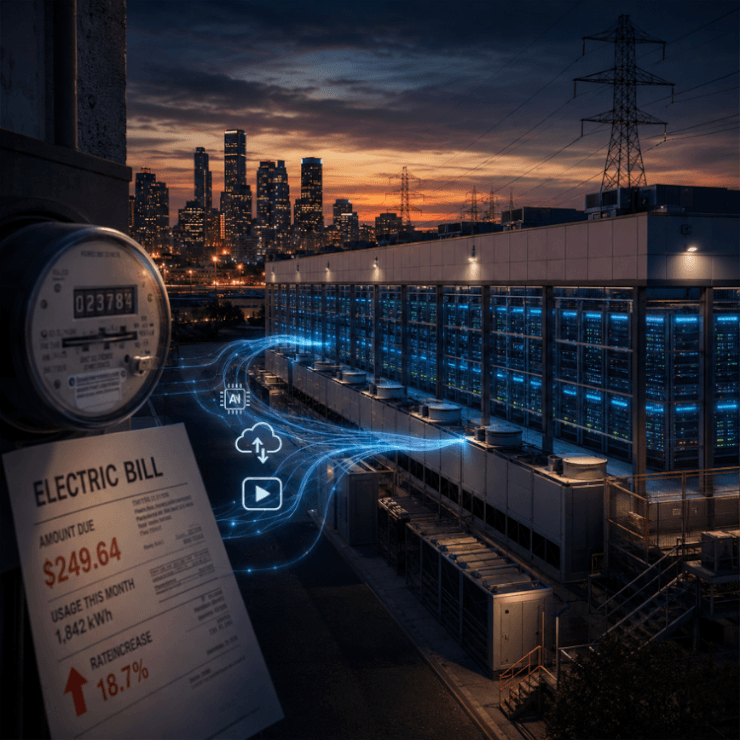
Are AI Data Centers Driving Up Your Electric Bill?
Understanding one of the biggest energy conversations in America.
Most people do not think about electricity until the bill arrives.
Then suddenly, the question becomes very real:
Why is my electric bill getting so expensive?
The answer is not as simple as one headline, one company, or one technology. Fuel prices matter. Weather matters. Aging infrastructure matters. Utility investments matter. Population growth matters. Electrification matters.
But now, another major force has entered the conversation:
Artificial intelligence and the massive data centers required to power it.
Behind every AI search, every cloud backup, every streaming platform, every online transaction, every business application, and every AI-generated image, there is physical infrastructure consuming real electricity.
Most people never see these facilities. They simply hear words like “cloud,” “AI,” or “digital transformation.” But the cloud is not floating in the sky. It lives in buildings filled with servers, cooling systems, backup power, transformers, and enormous electrical loads.
According to the U.S. Department of Energy, data centers consumed about 4.4% of total U.S. electricity in 2023 and are expected to consume approximately 6.7% to 12% of total U.S. electricity by 2028.
https://www.energy.gov/articles/doe-releases-new-report-evaluating-increase-electricity-demand-data-centers
Lawrence Berkeley National Laboratory reported the same key findings, noting that total U.S. data center electricity use increased from 58 terawatt-hours in 2014 to 176 terawatt-hours in 2023, with projections of 325 to 580 terawatt-hours by 2028.
https://newscenter.lbl.gov/2025/01/15/berkeley-lab-report-evaluates-increase-in-electricity-demand-from-data-centers/
This is not just a technology story.
It is an energy story.
And whether people realize it or not, it is quickly becoming a household budget story, a business operating-cost story, and a community planning story.
Are Data Centers Paying Less Than Families?
One of the biggest questions people are asking is whether large data centers are paying less for electricity than the average family.
The honest answer is:
Often, yes, on a price-per-kilowatt-hour basis, large commercial and industrial customers generally pay less than residential customers.
The U.S. Energy Information Administration publishes average retail electricity prices by customer class. These national averages consistently show that residential customers pay more per kilowatt-hour than commercial and industrial customers.
https://www.eia.gov/electricity/monthly/epm_table_grapher.php?t=table_5_03
At first glance, that can sound unfair.
Why should the largest users of electricity pay less per kilowatt-hour than a family trying to keep the lights on and the house cool?
The answer is more complicated than most people realize.
Large industrial customers often buy enormous amounts of electricity. Many connect to the grid differently than homes do. A residential customer depends on neighborhood-level infrastructure: poles, wires, transformers, meters, service crews, storm repair, distribution systems, and local maintenance.
A large facility may connect at higher voltage and may not require the same type of local distribution infrastructure that serves residential neighborhoods. That difference in cost structure can result in lower per-kilowatt-hour pricing.
So the issue is not as simple as saying, “Data centers pay less, therefore something is wrong.”
The more important question is this:
The Bigger Question: Who Pays for Grid Upgrades?
Data centers do not just consume electricity. They can require major grid upgrades.
Utilities may need to build or upgrade:
- Transmission lines
- Substations
- Transformers
- Generation capacity
- Grid-control systems
- Backup resources
- Interconnection infrastructure
These investments can cost billions of dollars.
Harvard Law School’s Environmental and Energy Law Program explains that data centers may increase electricity costs in two major ways: utilities may build new infrastructure to serve data centers and spread those costs across ratepayers, and increased demand can raise market prices when supply does not grow fast enough.
https://hls.harvard.edu/today/how-data-centers-may-lead-to-higher-electricity-bills/
That is why some states and regulators are paying close attention.
Oregon regulators approved a large-load tariff framework for Portland General Electric customers. The purpose is to create a separate structure for very large users, including data centers, so existing customers are better protected from costs created by rapid large-load growth.
https://www.utilitydive.com/news/oregon-puc-approves-pges-large-load-tariff-framework-for-data-centers/821361/
That is the type of policy conversation more people should understand.
The question is not whether technology should grow.
The question is whether growth is being paid for fairly.
Electric Bills Are Already Rising
Electric bills have been increasing across many parts of the country.
The U.S. Energy Information Administration reported that total average revenues per kilowatt-hour increased by 6.0% from April 2025 to April 2026. Residential average revenues per kilowatt-hour increased by 7.3% during that same period.
https://www.eia.gov/electricity/monthly/update/end-use.php
Data centers are not the only reason electricity costs are rising.
That matters.
If we blame everything on AI or data centers, we miss the full picture. Electricity costs are affected by many forces:
- Fuel costs
- Inflation
- Transmission investment
- Grid modernization
- Storm hardening
- Extreme heat and cold
- Retiring power plants
- Electrification
- Industrial growth
- Data center expansion
But data centers are now large enough that they can no longer be treated as a minor part of the conversation.
Which States Are Being Affected the Most?
The impact of data centers is not spread evenly across the country.
Some regions are seeing far more pressure because they have become major data center hubs.
Northern Virginia remains one of the most important examples. It is widely considered the largest data center market in the world. Because of this concentration, the PJM Interconnection region has become one of the most important areas to watch.
PJM is the regional transmission organization that coordinates electricity across all or parts of 13 states and Washington, D.C. PJM has reported significant long-term load growth, with data centers and other large loads playing a major role in that forecast.
https://insidelines.pjm.com/pjms-updated-20-year-forecast-continues-to-see-significant-long-term-load-growth/
Recent reporting also shows that PJM has been under pressure from extreme heat, high demand, and the rapid growth of large loads, including data centers.
https://www.reuters.com/legal/litigation/biggest-us-power-grid-pjm-vote-managing-data-center-demand-2026-06-30/
States frequently mentioned in the broader data center and grid-demand conversation include:
- Virginia
- Georgia
- Texas
- Ohio
- Arizona
- Oregon
- Pennsylvania
- Illinois
However, it is important to be careful.
Not every state is affected in the same way. Not every utility allocates costs the same way. Not every data center project has the same grid impact.
That is exactly why people need better information.
The Noise Issue Nobody Talks About Enough
Most discussions about data centers focus on electricity.
But electricity is not the only issue.
Noise is becoming a serious concern in some communities.
Data centers require cooling equipment, mechanical systems, transformers, and backup generators. Some of that equipment can operate continuously.
Communities near data centers have raised concerns about constant humming noise, low-frequency sound, and quality-of-life impacts.
https://www.eesi.org/articles/view/communities-are-raising-noise-pollution-concernsabout-data-centers
This matters because energy infrastructure is not just about power bills.
It is also about quality of life.
It affects neighborhoods, sleep, property use, water demand, land use, transmission corridors, backup generators, and community planning.
Again, this is not an argument against technology.
It is an argument for responsible growth.
What Can People Actually Do?
This is where the conversation needs to move beyond blame.
It is easy to say:
“AI is causing higher electric bills.”
It is easy to say:
“Utilities are charging too much.”
It is easy to say:
“Just use less electricity.”
But none of those statements fully solve the problem.
Yes, basic conservation matters. Turning off lights, adjusting thermostats, using ceiling fans properly, sealing air leaks, and improving habits can all help.
But I believe we need to ask a better question:
Energy Monitoring
You cannot manage what you cannot see.
Energy monitoring helps people and businesses understand where electricity is being used, when usage spikes, and which systems may be quietly draining money month after month.
For a home, that may mean understanding HVAC usage, appliances, electric water heating, refrigeration, or standby loads.
For a business, it may mean looking at refrigeration, motors, pumps, lighting, HVAC, compressors, commercial kitchens, car wash equipment, laundry, office equipment, or manufacturing systems.
Many people are not wasting energy intentionally.
They simply do not know where the waste is happening.
Smart Thermostats and HVAC Controls
Heating and cooling are often major drivers of electric bills, especially during extreme weather.
ENERGY STAR says certified smart thermostats are independently certified, based on actual field data, to deliver energy savings. ENERGY STAR also states that average savings are approximately 8% of heating and cooling bills, or about $50 per year, though savings vary based on climate, comfort preferences, occupancy, and HVAC equipment.
https://www.energystar.gov/products/heating_cooling/smart_thermostats/smart_thermostat_faq
This is not about being uncomfortable.
It is about not paying to heat or cool empty spaces, poorly scheduled zones, or rooms that are not being used.
Demand Response Programs
Demand response programs are designed to reduce or shift electricity use during peak demand events.
The U.S. Department of Energy describes demand response as a short-term, voluntary decrease in electricity consumption that is generally triggered by compromised grid reliability or high wholesale market prices. Customers may receive a rate discount, bill credit, or other compensation for curtailing load or committing to do so.
https://www.energy.gov/cmei/femp/demand-response-and-time-variable-pricing-programs
This matters because peak electricity is often the most expensive electricity on the grid.
During extreme heat, when millions of air conditioners are running at the same time, reducing demand even temporarily can help stabilize the grid.
Virtual Power Plant Programs
Virtual Power Plants, often called VPPs, connect distributed energy resources so they can help support the grid.
These resources may include batteries, smart thermostats, EV chargers, and other flexible loads.
The U.S. Department of Energy says VPPs are a key near-term solution to energy challenges including rising costs, interconnection backlogs, peak demand increases, and distribution system congestion.
https://www.energy.gov/edf/virtual-power-plants-projects
For eligible homeowners in some markets, VPP opportunities may provide incentives for participating with qualifying home energy systems.
Terms and conditions apply. Not everyone qualifies. Availability depends on the program, the utility, and the market.
But the idea is powerful.
Instead of every home being only a consumer of electricity, homes can become part of a coordinated system that helps reduce stress on the grid during critical times.
Community Solar
Community solar allows eligible participants to receive bill credits from a shared solar project without installing panels on their own roof.
This matters for renters.
It matters for people with shaded roofs.
It matters for people who do not want rooftop solar.
It matters for people who cannot install panels where they live.
Community solar is not available in every state or every utility territory. Where it is available, it can be one of the simplest ways for people to participate in renewable energy without owning a solar system.
Supplier Choice in Deregulated Markets
In deregulated electricity markets, customers may have the ability to choose their electricity supplier.
That does not automatically mean every offer is better.
It does not mean everyone will save.
It means people need to understand their options, compare carefully, and make informed decisions.
Some programs are designed to monitor electricity supply opportunities and notify customers when a qualifying lower-priced offer may be available.
Programs like that need to be explained clearly.
- No one should guarantee savings unless the program terms support that claim.
- Eligibility matters.
- Market conditions change.
- The utility territory matters.
- The details matter.
The important thing is not hype.
The important thing is helping people understand what options may exist where they live.
Energy Optimization and Power Quality
Most people think lowering an electric bill only means using less electricity.
But there is another question:
How efficiently is the electricity being used?
Power quality, voltage irregularities, harmonics, surges, and inefficient electrical consumption can affect how equipment performs.
For homes and businesses, energy optimization and power-quality technologies may help reduce waste, protect equipment, and improve overall electrical performance where they are a good fit.
This is not magic.
It is not one-size-fits-all.
But it is part of a smarter energy conversation, especially for businesses with motors, pumps, refrigeration, HVAC, compressors, lighting, or other significant electrical loads.
Commercial Energy and Water Reviews
Businesses often have larger opportunities than they realize.
A restaurant, hotel, car wash, grocery store, manufacturing facility, apartment complex, warehouse, or office building may have hidden waste across multiple areas.
- Electricity
- Water
- Sewer
- HVAC
- Refrigeration
- Lighting
- Pumps
- Motors
- Power quality
- Controls
- Billing errors
- Operational inefficiencies
The opportunity is not always one massive fix.
Sometimes it is several smaller improvements that add up.
Sometimes the fastest way to improve cash flow is not selling more.
Sometimes it is finding the leaks that have quietly become normal.
The Real Issue Is Awareness
AI is not going away.
Data centers are not going away.
Electricity demand is not going down.
So the real question becomes:
How do we respond?
We can argue about who is to blame, or we can start asking better questions.
- Are large energy users paying their fair share?
- Are utilities allocating infrastructure costs fairly?
- Are states protecting residential customers and small businesses?
- Are communities being heard before major projects are approved?
- Are homes and businesses using electricity efficiently?
- Are people aware of programs that may already be available?
- Are we producing more energy while still wasting too much of what we already generate?
Those are the questions that matter.
My Perspective
I am not anti-technology.
I am not anti-AI.
I am not anti-growth.
But I do believe growth should be responsible.
If data centers require massive grid upgrades, the public deserves transparency about who pays for them.
If families, renters, businesses, and communities are seeing higher bills, they deserve to understand why.
If neighborhoods are dealing with noise, water concerns, transmission projects, or backup generator pollution, they deserve to be included in the conversation.
And if there are programs and technologies that can help people reduce costs, improve efficiency, and use energy more intelligently, they deserve to know those options exist.
That is where I focus my energy.
I help people, renters, homeowners, businesses, contractors, organizations, and communities better understand what options may be available and connect with trusted resources when it makes sense.
Because the future of energy is not only about producing more.
It is about wasting less.
It is about smarter systems.
It is about fairer cost allocation.
It is about better information.
It is about helping people make better decisions before the next bill shows up.
And the cheapest energy mistake is the one you catch before it keeps draining money month after month.
Sources and References
- U.S. Department of Energy, “DOE Releases New Report Evaluating Increase in Electricity Demand from Data Centers”
https://www.energy.gov/articles/doe-releases-new-report-evaluating-increase-electricity-demand-data-centers - Lawrence Berkeley National Laboratory, “Berkeley Lab Report Evaluates Increase in Electricity Demand from Data Centers”
https://newscenter.lbl.gov/2025/01/15/berkeley-lab-report-evaluates-increase-in-electricity-demand-from-data-centers/ - U.S. Energy Information Administration, Electric Power Monthly, “Average Price of Electricity to Ultimate Customers: Total by End-Use Sector”
https://www.eia.gov/electricity/monthly/epm_table_grapher.php?t=table_5_03 - U.S. Energy Information Administration, Electricity Monthly Update, End Use
https://www.eia.gov/electricity/monthly/update/end-use.php - Harvard Law School, “How data centers may lead to higher electricity bills”
https://hls.harvard.edu/today/how-data-centers-may-lead-to-higher-electricity-bills/ - Utility Dive, “Oregon PUC Approves PGE’s Large-Load Tariff Framework for Data Centers”
https://www.utilitydive.com/news/oregon-puc-approves-pges-large-load-tariff-framework-for-data-centers/821361/ - PJM Interconnection, “PJM’s Updated 20-Year Forecast Continues to See Significant Long-Term Load Growth”
https://insidelines.pjm.com/pjms-updated-20-year-forecast-continues-to-see-significant-long-term-load-growth/ - Reuters, “Biggest US power grid PJM moves towards managing data center demand”
https://www.reuters.com/legal/litigation/biggest-us-power-grid-pjm-vote-managing-data-center-demand-2026-06-30/ - Environmental and Energy Study Institute, “Communities Are Raising Noise Pollution Concerns About Data Centers”
https://www.eesi.org/articles/view/communities-are-raising-noise-pollution-concernsabout-data-centers - ENERGY STAR, Smart Thermostats FAQ
https://www.energystar.gov/products/heating_cooling/smart_thermostats/smart_thermostat_faq - U.S. Department of Energy, “Demand Response and Time-Variable Pricing Programs”
https://www.energy.gov/cmei/femp/demand-response-and-time-variable-pricing-programs - U.S. Department of Energy, “Virtual Power Plants Projects”
https://www.energy.gov/edf/virtual-power-plants-projects